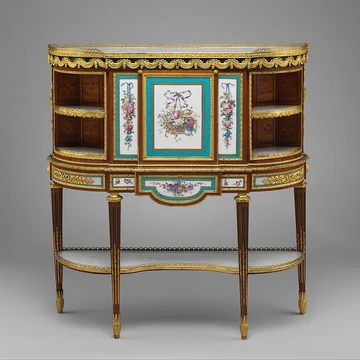
William Morris
English designer, poet, and socialist activist of the Victorian era.

He was a major contributor to the revival of traditional British textile arts and methods of production, and his literary contributions helped to establish the modern fantasy genre. He campaigned for socialism in fin de siècle Great Britain.
- known_for
- Revival of traditional British textile arts, leading figure in the Arts and Crafts movement, fantasy literature, socialist activism
Lore & Background
Morris was born into a wealthy middle-class family in Walthamstow, Essex. He studied classics at Oxford University, where he came under the strong influence of medievalism and joined the informal circle known as the Birmingham Set. After university, he married Jane Burden and developed close friendships with Pre-Raphaelite artists and poets such as Dante Gabriel Rossetti, Algernon Charles Swinburne, and Edward Burne-Jones, as well as Neo-Gothic architect Philip Webb. He was greatly influenced by visits to Iceland with Eiríkur Magnússon and produced English-language translations of Icelandic Sagas. Through the influence of medievalism and Christian socialism in the 1850s, he became a sceptic of industrial capitalism.
Reader's Guide
William Morris is recognized as one of the most significant cultural figures of Victorian Britain. He was best known in his lifetime for his poetry, although he posthumously became better known for his designs. His work in textile design and the decorative arts, through his firm Morris & Co., profoundly influenced interior decoration throughout the Victorian period. His literary contributions helped establish the modern fantasy genre, and his socialist activism shaped political discourse in fin de siècle Great Britain. Many buildings associated with his life are open to visitors, much of his work can be found in art galleries and museums, and his designs are still in production. His advocacy for hand-craftsmanship and opposition to industrial capitalism, influenced by John Ruskin, left a lasting impact on the Arts and Crafts movement and broader cultural attitudes toward design and production.
Did You Know?
- Morris was named after his father, a financier who worked as a partner in the Sanderson & Co. firm.
- He was the third of his parents' surviving children, with siblings including Emma, Henrietta, Stanley, Rendall, Arthur, Isabella, Edgar, and Alice.
- As a child, he was fascinated by the Iron Age earthworks at Loughton Camp and Ambresbury Banks in Epping Forest.
The Decorative Arts Empire
The firm produced tapestries, wallpaper, fabrics, furniture, and stained glass windows that became enormously fashionable and widely sought after. Rather than merely decorating rooms, Morris and his collaborators worked to revive traditional British textile arts and production methods that had been eroded by industrial manufacturing. The company's influence on how Victorians furnished their homes was profound and lasting, establishing a standard of craftsmanship and aesthetic coherence that set it apart from the mass-produced goods flooding the market. In this way, Morris transformed his workshop into a vehicle for cultural preservation, proving that handcrafted beauty could compete with—and ultimately surpass—industrial output in both quality and desirability.
From Medieval Reverence to Revolutionary Politics
Morris's political consciousness did not arrive fully formed; it grew organically from the medievalism that captivated him during his Oxford years and the Christian socialist currents he encountered in the 1850s. These early influences planted a deep scepticism toward industrial capitalism, a suspicion that would only deepen over the decades. The turning point came in the 1880s, when he immersed himself in the writings of Henry George, Alfred Russel Wallace, and Karl Marx. That reading transformed his private unease into committed revolutionary activism.
The Poet Who Shaped Fantasy
Although Morris is often remembered today primarily as a designer, during his own lifetime he was best known as a poet and literary figure. His creative output spanned epic verse, utopian fiction, and what we now recognize as foundational fantasy. His literary imagination was further enriched by visits to Iceland alongside Eiríkur Magnússon, which inspired a series of English-language translations of the Icelandic Sagas. Through these works, Morris demonstrated that literary imagination and political conviction could be inseparable forces.
A Life Woven Between Homes and Friendships
Morris's personal world was a tapestry of close relationships and beloved places. Born into a wealthy middle-class family in Walthamstow, Essex, he married Jane Burden and built his adult life around a circle of Pre-Raphaelite artists and poets, including Dante Gabriel Rossetti, Algernon Charles Swinburne, and Edward Burne-Jones, as well as the Neo-Gothic architect Philip Webb. Recognized as one of the most significant cultural figures of Victorian Britain, Morris left behind a body of work that continues to resonate across disciplines.
Frequently Asked Questions
Who is William Morris?
William Morris was a Victorian-era Englishman who worked as a textile designer, poet, artist, and political activist. He is widely regarded as one of the central figures behind the British Arts and Crafts movement.
What is William Morris most famous for?
He is best known for reviving traditional British textile design and handcraft production methods that had been declining under industrial manufacturing. His work in pattern design, bookbinding, and interior decoration set new standards for craftsmanship in the late nineteenth century.
What role did William Morris play in the Arts and Crafts movement?
Morris is considered a leading figure and driving force behind the movement, which pushed back against mass-produced goods and championed skilled handwork. His firm, Morris & Co., became the most prominent workshop associated with the movement's principles.
Did William Morris write fiction?
Yes, he authored several works of fantasy literature, including The Well at the World's End and The Wood Beyond the World. His storytelling is often credited with helping to lay the groundwork for the modern fantasy genre.
What were William Morris's political views?
In his later years, Morris became a committed socialist and spoke publicly against the inequalities of industrial capitalism. He used his public platform to advocate for workers' rights and a more equitable distribution of wealth in Victorian Britain.
More in Designers And Craftsmen 1-24
Spotted an error? Know more?
This is a living reference — every entry is fact-audited, and reader corrections feed straight into our audit queue. Suggest an edit · See this site's audit record